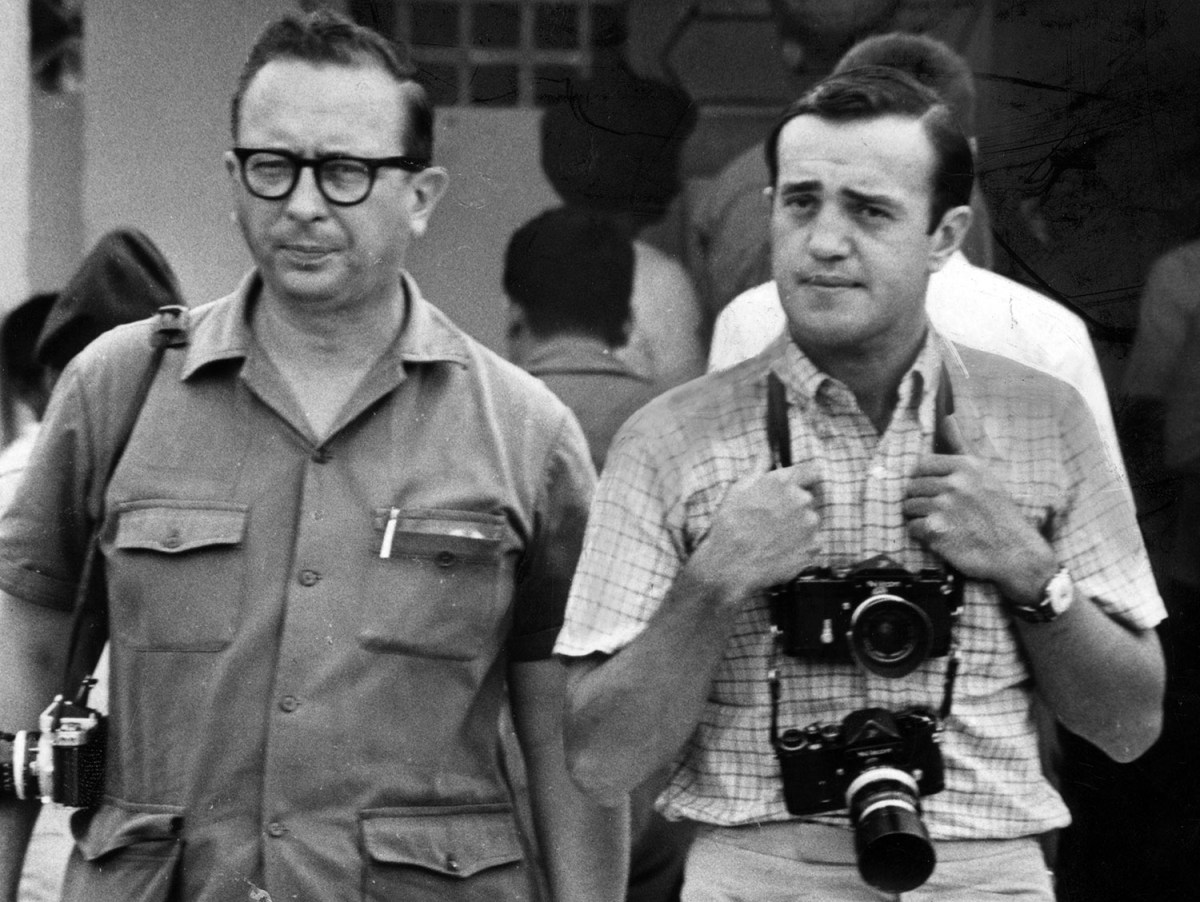
The Vietnam War (1955-75) was an era of unprecedented controversy in the history of the United States as the tension of the cold war escalated so high that the country relentlessly fought against any potential enemies alleged of communism. The role of the media, especially news coverage and live reporting on television, has been widely noted, too. It enabled easier and wider news coverage as more households in the U.S. obtained access to televisions since the 1960s. However, Vietnam has become the subject of large-scale news only after substantial numbers of U.S. combat troops had been committed to the war in the spring of 1965. Prior to that time, there were only fewer than two dozen U.S. journalists working at the Indochina area. By 1968, at the climax of the war, about 600 accredited journalists of all nationalities work in Vietnam, reporting for wire services, radio, television networks and major newspapers and magazines. The U.S. Military Assistance Command, Vietnam (MACV) made military transportation readily available to newspeople, which not only warranted journalists to venture into battlefields to bring back stories firsthand but also facilitates unprecedented social impact to the public opinion, the revolution of journalism as well as the surge of television programs.[i]
Journalists televising the warfare from the front lines took the historical advantage of the advancement in video and audio recording and the popularization of televisions in households of the United States. From 1950 to 1966, the percentage of Americans who owned a television skyrocketed from 9% to 93%, which virtually became an essential part of people’s everyday life.[ii] In 1964, a study showed that 58% of people receive “most of their news” from television. By 1972, the number increased to 64%.[iii] Network correspondents provided live coverage of battles, injuries and death in an unprecedented way. Film from Vietnam was flown to Tokyo for quick development and editing and then flown on to the United States. Important stories can be transmitted directly by satellite from Tokyo. There has been much debate over the way that television brought the warfare into American living rooms, but most stories, indeed, were filmed soon after the battle instead of in the midst of one. Moreover, most stories about the war on nightly television news shows were not film records retrieved directly from correspondents in Vietnam, but rather brief reports based on wire service dispatches and read by anchormen.[iv]
As such, television’s impact can be boiled down into two aspects: television’s visual nature and its primary focus on the negative news. Television programs have the ability to exhibit the raw horror of the warfare, which print and broadcast journalism cannot. Thus, Americans can watch firsthand not only the battered or bombarded landscape of Vietnam’s villages, buildings and jungles but also battered American soldiers. Moreover, television coverage focused on negative news more so than print as television stations were constantly competing for ratings. It was more sensational to report negative news that happened in Vietnam, including lost battles, soldier casualties and corruption within the American administration. A study conducted in the mid-1970s found that Vietnam War television coverage was more memorable to viewers than regular evening news stories.[v] The undisguised terror and various negative news stories showcased by television programs undoubtedly impacted the nation psychologically, which afterward contributed to the growing unrest during the years of conflict.
Another distinguishing feature of journalism during the era of the Vietnam War is its heavy focus on commentary content. In World War II, as well as other conflicts following the Vietnam War, the military banned journalists from the front lines, and the war was covered from a distance. While, as MACV made military transportation accessible to journalists and government forsook to censor sensitive contents transmitted from the front line, no previous war had been so accessible and free to journalists and, therefore, the American public. Furthermore, with the radical freedom to air any content related to Vietnam, by 1968, figureheads were making an increasing number of editorial comments. A study found that North Vietnam reporting received about 20 comments from television’s major players, and South Vietnamese coverage received about 10.[vi] For this reason, government officials were often enraged by what the networks were airing, as it often provokes public displeasure and distrust toward the authority. For example, a program aired by CBS in 1965 detailed how an American military company had destroyed an entire Vietnamese village thought to be launching guerilla attacks. The documentary showcased the American soldiers as “unsure of their military objective and unimpressed by their own officers.”[vii] These acrid comments, without any doubt, fueled the growing anti-war sentiment and movement within the U.S.
Moreover, television journalism impacted public opinion regarding warfare in a profound and unexpected way. Some believe that the media played a large role in the defeat of the U.S. as media’s tendency toward negative reporting helped to undermine the public’s support back home, and the uncensored coverage provided precise information to the enemy. However, many experts studying the role of media during the Vietnam War concluded that most reporting prior to 1968 is supportive of America.[viii] The watershed of the public opinion, as many experts pointed out, was the Tet Offensive. On Jan. 30, 1968, the Vietcong attacked 120 American and South Vietnamese locations. Though the U.S. later regained all the ground lost in the offensive, it was a huge political defeat in terms of the morale and public trust within the U.S., in part due to the media coverage. The American public was shocked to see Marines strived to protect the U.S. embassy in Saigon. Also, a photograph of a South Vietnamese general executing a Vietcong prisoner forced the public to question their allies. Walter Cronkite, the anchor of the CBS Evening News, who was also known as “the most trusted man in America,” claimed that the U.S. was “mired in stalemate.” Later, President Lyndon Johnson, whilst announcing that he would not seek reelection in 1968, stated that “No one can say exactly what effect those vivid scenes have on American opinion.” With this message, directed at a meeting of the National Association of Broadcasters, we could observe that in many people’s minds, including Johnson, releasing scenes from the Vietnam War to the American public made victory impossible. In September 1968, American public war support dropped to its historical lowest—merely 19%, and this was largely due to the role that journalism played in the war.[ix]
In conclusion, visual journalism is a great controversy in the era of the Vietnam War. Its visual nature, primary focus on the negative news, commentary feature, and impact on public opinion played a vital role in the development of televised warfare. Vietnam War revealed the power of television news from a new perspective, and the inevitable effect it had on public opinion effectively fueled the anti-war movement in the latter half of the war.
[i] Spector, R. H. (2016, April 27). The Vietnam War and the media. Retrieved from https://www.britannica.com/topic/The-Vietnam-War-and-the-media-2051426
[ii] Vietnam: the First Television War. (n.d.). Retrieved from https://prologue.blogs.archives.gov/2018/01/25/vietnam-the-first-television-war/
[iii] Daniel C. Hallin, The Uncensored War (New York: Oxford), 106
[iv] Spector, R. H. (2016, April 27). The Vietnam War and the media. Retrieved from https://www.britannica.com/topic/The-Vietnam-War-and-the-media-2051426
[v] Hallin, The Uncensored War, 107
[vi] Hallin, The Uncensored War, 149
[vii] Pierson, American Television News, page 39
[viii] Spector, R. H. (2016, April 27). The Vietnam War and the media. Retrieved from https://www.britannica.com/topic/The-Vietnam-War-and-the-media-2051426
[ix] Hallin, The Uncensored War, 157

 Xiangyuan Chi