
As demonstrations continue all over the world to protest against the death of George Floyd and express frustration over the longstanding systematic racism, the movement has received generous support across people from all races. Yet, there have been significant unsupportive voices raised within Asian American communities, which evinced the persistent anti-black sentiment among them.
“It is a common rule in Korean families that we can’t date a black boyfriend or girlfriend, not even an Afro-Asian like my ex,” Cho-Hee Lee, a Ph.D. candidate of sociology at Peking University, told me on the phone.
A variety of reasons, like the history of racism toward Asian and Confucianism teachings, bred a complex mixture of anti-Black sentiments in Asian American communities.
A series of police violences and killings of unarmed black people brought about heated discussion over racial equality again, which, meanwhile, reminded us that Asian Americans occupy a murky space in the discussion of racial justice as they might be both victim and complicit of the rampant racism in the society.
Against the backdrop of the coronavirus pandemic, in which many Asian Americans have been assaulted, spat on, stabbed, or even burned alive, many of them were compelled or primed to protest against racial inequality and police brutality.
“I would absolutely go to a demonstration if I were in the States right now,” says Sicheng Zhong, an influencer on Weibo about DEI issues for ethnic minorities in China.
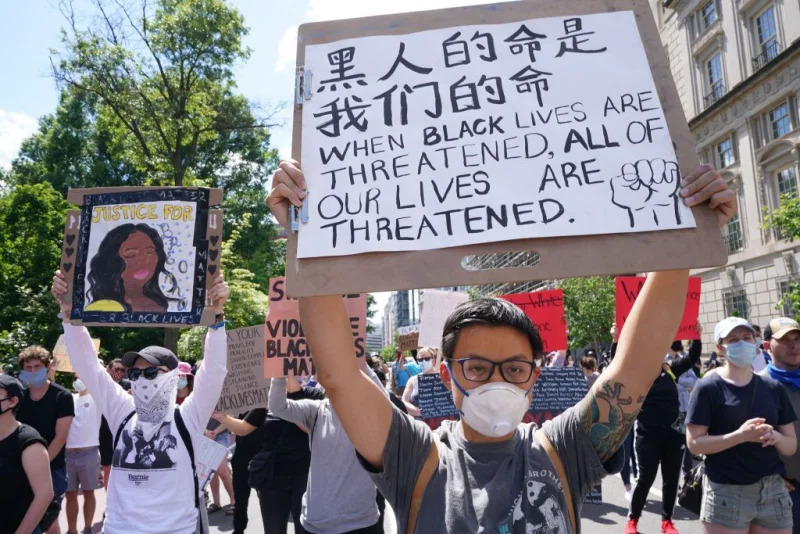
However, while at least 75% of Asian Americans have shown support to the Black Lives Matter movement, per to the study from the Pew Research Center, disputes have been sparked over whether Asians should participate in the movement that mainly focuses on Black people’s rights.
Since the end of WWII, many renowned scholars and politicians have used Asian Americans and their perceived collective success as a racial wedge to minimize the struggles minority groups face in society.
In 1966, William Peterson, a sociologist at the University of California, Berkeley, helped popularize the conflict between Asian and Black Americans by writing in his New York Times column, “…we barely know how to repair the damage that the slave traders started. The history of Japanese Americans, however, challenges every such generalization about ethnic minorities.”
In short, politicians were trying to put down the Black Power Movement in the 1960s by claiming, “Asians have experienced racism in this country, but because of hard work, they’ve been able to pull themselves up out of racism, so why can’t you,” says Lanxin Li, a Ph.D. candidate of sociology at London School of Economics and Political Science.
Thus, the biased compliment that Asian Americans are more successful than other ethnic minorities because they work hard, receive tertiary education, and abide law was accepted by many Asian Americans, Li says.
Moreover, the notion of the model minority “also coincides with Confucianist teaching that we shall work hard to attain success, which makes it even more acceptable to some Asian Americans,” Li says.
What’s worse, the sentiment of model minority created “racial resentment,” which refers to a “moral feeling that Blacks violate such traditional American values as individualism and self-reliance,” as defined by political scientists Donald Kinder and David Sears.
“To say that there’s an advanced minority is implying that there is essentially a bad minority, which, therefore, helped root the anti-blackness sentiment among many Asian communities,” says Lee.
Furthermore, the underrepresentation of Asian culture also plays a pivotal role in cultivating the anti-blackness sentiment among Asian Americans.
Asians were also victims of systemic racial discrimination as early as the 18th century when thousands of Chinese immigrants entered the U.S. as coolies who built transcontinental railroads as well as other infrastructure projects. Yet, Chinese at that time are villainized as “Yellow Peril,” and the Chinese Exclusion Act of 1882 also denied Chinese laborers’ contribution to the country and their opportunity to obtain citizenship.
While most Americans reflect on their history of discrimination and build solidarity with other ethnic minorities, the rest of them, combined with precarious cultural identity, are eager to prove their “Americanness” by assimilating to the white dominance to integrate into the mainstream society.
This inclination of some Asian Americans to adhere to the white culture penetrates people of all backgrounds. For instance, in response to the grievous assault that Asians encountered because of the COVID-19 pandemic, Andrew Yang, former presidential candidate and serial entrepreneur, wrote in The Washington Post: “We Asian Americans need to embrace and show our American-ness in ways we never have before.”
As such, Asian Americans are entrenched in the sentiments that they are inevitably foreign–based on their appearance–and the temptation to ally with white so as to become a part of mainstream society. Those sentiments invalidate claims of inequality toward other non-white groups and set assimilation to White predominance as a primary goal of ethnic minorities, which eventually exacerbates inequality for all ethnic minorities.
“We don’t know what our role in this conversation should be,” says Lee, “Given our tenuous place in American society, no wonder so many Asian Americans might want to dream of acceptance by a white-dominated society and refuse to join the BLM movement.”
Therefore, without a firm cultural identity in society’s mainstream, it is easy for Asians to get lost in such a movement that primarily calls out inequality for Blacks.
“There is tremendous diversity among Asian Americans,” Zhong says. “It is not a surprise for me to see different attitudes, but it’s painful to see so many negative reactions among Chinese toward the movement.”

 Xiangyuan Chi