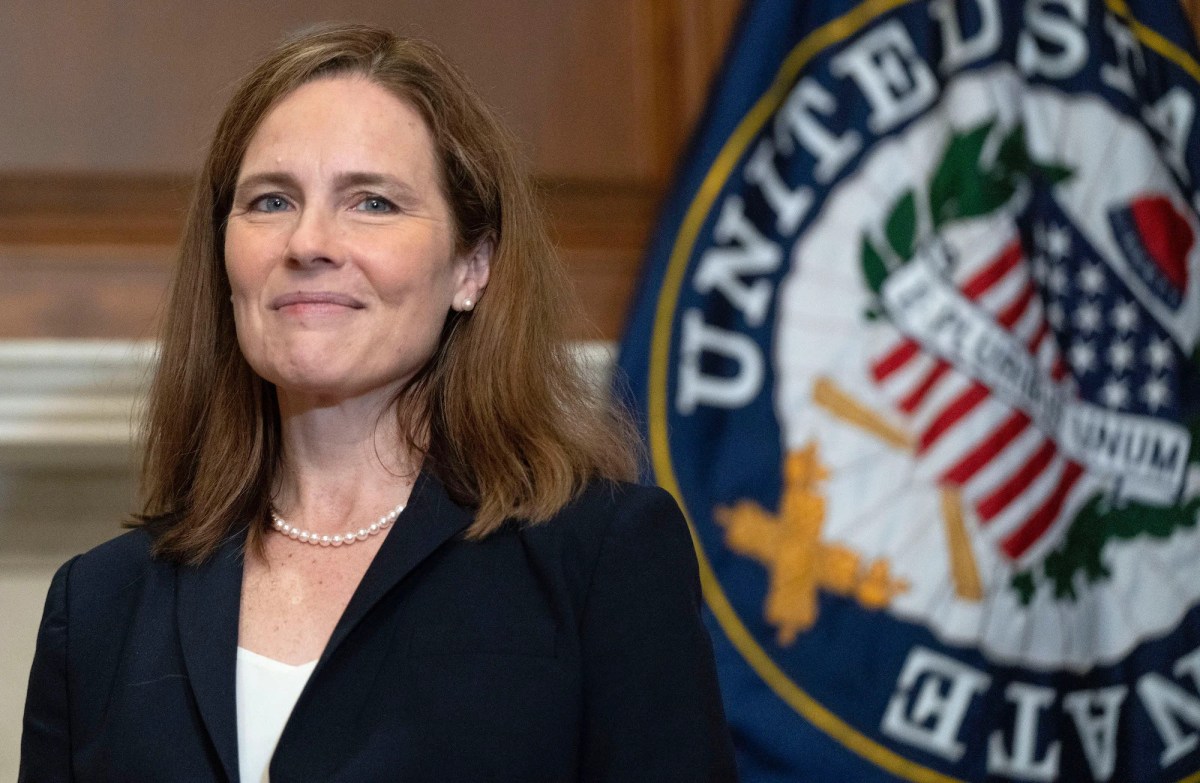
It was more than fortunate for me to have a chance meeting Justice Amy Coney Barrett in person when I was in an exchange program at Yale in 2017. During an office hour of a law professor for exchange students from high school, Justice Barrett was invited by chance as a courtesy of two female legal thinkers’ friendship. At that time, frankly speaking, I know nothing about American legal system, but her discussion did take my breath away. She talked about approaching Constitution in the entire 30-minute talk. Even though I learned that Constitution played a vital role in the independence of the country from my AP U.S. History class, I have never imaged that the document still serves as a fundamental guide for litigations in this day and age.
Justice Barrett is a devout catholic and a legal thinker who clings to originalism, which refers to the school of thought that the Constitution must be interpreted based on the original understanding when it was ratified. Her legal philosophy and belief, in addition to her records in the 7th U.S. Circuit Court of Appeals, makes her a favorite among social and religious conservatives.
Among the decisive issues that Justice Barrett has unashamedly dissented during her time at the appeals bench, from guns and sexual assaults to Affordable Care and abortion rights, Barrett proved herself to be a conservative jurist and legal thinker. Her evident inclination toward imposing limitations on abortion concerned not only members of the Judiciary Committee but also people who upholds reproductive freedom of women.
During Amy Coney Barrett’s confirmation hearing for the Court of Appeals in 2017, Sen. Dianne Feinstein (D-Calif.) disputes her clean and consistent devotion to Catholicism and made her famous remark that “The dogma lives loudly within you, and that’s of concern.”
Sen. Feinstein’s questioning about whether her firm religious belief could affect her rulings as a judge lingered as the most central criticism toward the young judge until she was confirmed to fill Justice Ginsberg’s chamber in the Supreme Court, a week before the election day of 2020.
As she has successfully assumed her seat in the Supreme Court, which solidified a 6-3 majority for conservative judges, it is important to analyze how she is going to change the landscape of abortion rights in the United States.
Her legal philosophies
Several years after graduating from Notre Dame Law School with summa cum laude honor, she clerked for the justice Antonin Scalia, who led the conservative wing of the high court before his death in 2016. During her clerkship with the late Supreme Court Justice, she showed her considerable talent in the field of law and was nicknamed as “The Conenator” by her fellow law clerks for “destroying flimsy legal arguments.”
Meanwhile, Justice Scalia made a profound impact to Justice Barrett since then.
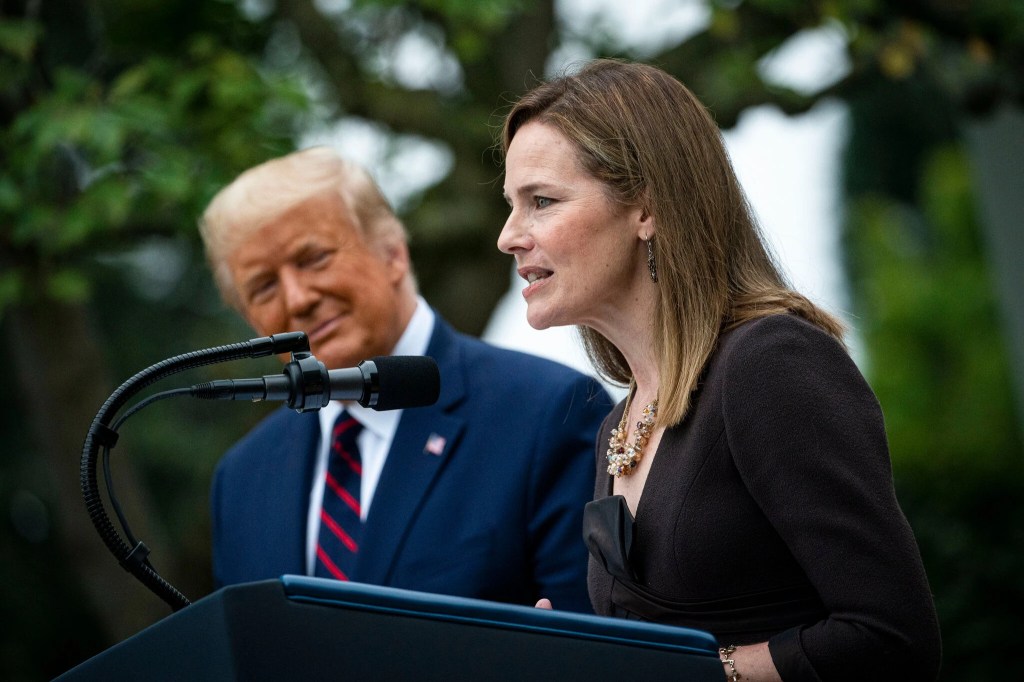
“I clerked for Justice Scalia more than twenty years ago, but the lessons I learned still resonate,” Barrett said after she was introduced by Trump at the White House Rose Garden. “Justice Scalia is a mentor…and his philosophy is mine,” Barrett attributed to Justice Scalia again in the Supreme Court confirmation hearing.
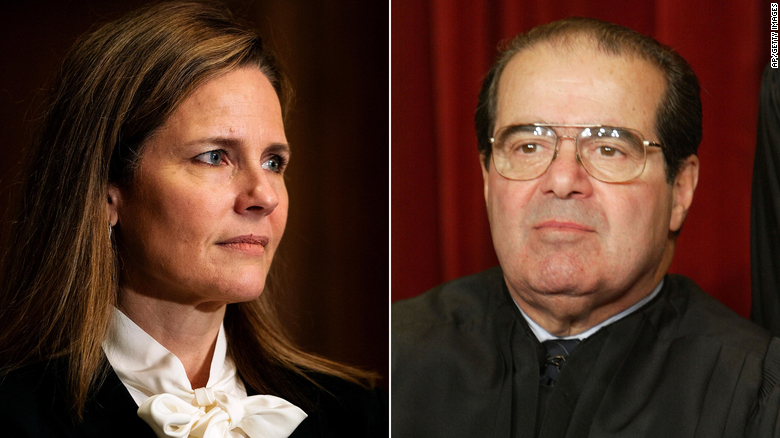
Knowing as a faithful defender of the Constitution and the foremost leader of originalists, Justice Scalia is famous for his opposition to gay rights, affirmative action, abortion rights and openly bashed that Roe v Wade is wrongly decided.
Therefore, people would naturally suspect that Barrett will emulate her mentor’s ideologue and make an effort to overturn the landmark precedent that proclaimed abortion as a constitutional right.
“[Barrett] admires Scalia so much, it would not be surprising to me that she will try to overrule the Roe v Wade,” says Susy Liu, a political correspondent at The Paper.
Moreover, even though her writings in the bench of appeals indicates that she is not the one who may prone to judicial tantrum and rhetorical abuse for the sake of her religious belief, people are still concerned that, as a Supreme Court Justice, she may not be strictly binding to the precedent of Roe like she was in the Court of Appeals, which is inferior to the high court.
This view is evident in her academic works as well.
“I tend to agree with those who say that a justice’s duty is to the Constitution and that it is thus more legitimate for her to enforce her best understanding of the Constitution rather than a precedent she thinks clearly in conflict with it,” she wrote in a law review article titled Precedent and Jurisprudential Disagreement.
“The fact that there is going to be six conservative judges made me feel like the prospect of abortion right is very dark,” laments Yining Bei, a J.D. candidate at Duke University School of Law.
A possibly radical pro-life supporter
The most striking and worrisome evidence for people who do not want to see Roe to be overruled is her record of commitment in multifarious pro-life organizations.

Disclosed by her senate questionnaire, Barrett was a member of the University Faculty for Life at Notre Dame from 2010 to 2016. The organization’s website shows that the group began promoting South Bend’s Women’s Care Center (WCC) in 2016. When local users search the term “abortion”, an ad of WCC appeared on the top of the result page.
The webpage of WCC claims that it offers abortion services and free pregnancy tests. However, if a user clicks the “abortion” menu, a window pops up and says, “If you’re considering abortion, we offer free, confidential services to help you find out the facts and make a plan that is best for you.”
In fact, according to local media reports, the clinic does not offer abortion services and is obviously supported by conservative pro-life groups in South Bend and at Notre Dame University.
Moreover, in 2006, when Barrett was a law professor at Notre Dame, she signed a letter published by the St. Joseph County Right to Life Group, an extreme anti-choice organization, which called for the overturning of Roe v Wade and called the monumental abortion rights decision “barbaric” and a “raw exercise of judicial power”.
Also, as Sen. Richard Blumenthal (D-Conn.) and Sen. Kamala Harris (D-Cali.) pressed in the confirmation hearing, Barrett didn’t disclose that she signed another newspaper ad that proposes to “renew our call for the unborn to be protected in law and welcomed in life, and we voice our love and support for the mothers who bear them.”
Barrett sidestepped from acknowledging that she didn’t disclose her record promptly and her alleged association with anti-choice organizations. In her response to Senators’ questions, she said, “It’s really no more than a pro-life view.”
These revelations add to an already immense body of evidence that Barrett, who has served as an appellate court judge since 2017, unswervingly advocates against abortion rights in some circumstances and publicly supported the reversal of Roe v Wade.
“It is indeed worrisome, but we have to notice that all of these letters are signed before 2017, when she became a judge. There is no way to attribute personal responsibilities for those letters according to Codes of Conducts [for United States Judges],” said Liu, “she managed the timing so well.”
Bei, however, is not perturbed about Barrett’s points. “For hundreds of years, there are always judges that have pretty strong religious beliefs. But judicial system needs judges coming from diversified background, which definitely includes people of conservative or religious backgrounds. Only by doing so could we have checks and balances in the court, whose decisions can be more representative for the American public.”
“My values and ethics differ dramatically from those of Justice Barrett, and I feel sad about the prospect of abortion rights in America, but that doesn’t mean that she is not a qualified judge and legal thinker,” says Bei, “we are just different.”
Barrett’s exact stance on issues related to abortion
Barrett’s opinion on Roe may be best characterized by her discussion at Jacksonville University, in which she said, “I think don’t think the core case – Roe’s core holding that, you know, women have a right to an abortion – I don’t think that would change. But I think the question of whether people can get very late-term abortions, how many restrictions can be put on clinics – I think that would change.”
During the presidential debate between Donald Trump and Hillary Clinton in 2016, when the moderator, Chris Wallace, pressed on both candidates that if they would overturn the ruling of Roe v Wade, Trump said, “that will happen automatically, in my opinion, because I’m putting pro-life justices on the court.”
Justice Barrett, the third nomination to the Supreme Court under Trump’s four-year presidency, naturally distresses people that she may be the one who put the abortion right established in Roe at stake.
Judge Barrett’s judicial opinions have evinced a uniformly conservative stance on cases that touches on the issue of abortion. However, none of the cases directly concerns the abortion rights per se, but imposing restrictions or modifications on it.
For instance, in her dissent concerning an Indiana law that bans abortions because of the sex, race or disability of the fetus which she called “eugenics statute”, she cites that even though Roe or Casey holds that a woman is entitled to decide whether to bear a child until a fetus is viable, “None of the Court’s abortion decisions holds that states are powerless to prevent abortions designed to choose the sex, race, and other attributes of children.”
“There is a difference between ‘I don’t want a child’ and ‘I want a child, but only a male’ or ‘I want only children whose genes predict success in life.’ Using abortion to promote eugenic goals is morally and prudentially debatable on grounds different from those that underlay the statutes Casey considered,” Barrett argued.
Moreover, in another statute which requires abortion providers to bury or cremate fetal remains, Judge Barrett, along with some other appeals judges, drew an analogy with animal-welfare statutes, saying that “Animal-welfare statutes are rational not simply because all mammals can feel pain and may well have emotions, but also because animal welfare affects human welfare. Many people feel disgust, humiliation, or shame when animals or their remains are poorly treated.”
As such, Barrett contends that human’s fetal remains should be reasonably treated as well since it would affect public’s sensibility and its low cost ($6 – $12, provided by court) “does not make abortion services harder to procure.”
Talking about the odds that the conservative high court would try to reverse the decision made by Roe, Lau and Bei, again, give dissimilar opinions.
“Even though Chief Justice John Roberts could control the court agenda, I think it would be highly possible that conservatives are going to try overturning Roe in the foreseeable future,” says Bei.
In comparison, Lau says, “Based on her past opinions, I don’t think she would like to reverse the Roe completely because the consequence of that would be unimaginable. But I am certain that she will tighten the requirements for acquiring abortion services if she has the chance to.”
In the confirmation hearing, when she was asked about whether she would follow her mentor’s reasoning that “Roe was wrongly decided,” Barrett dodges giving a forthright answer, but explained that originalists don’t always agree, like Scalia does not agree with Justice Clarence Thomas, which left her decision on cases that involves abortion rights unclear.
However, it is certain that the 48-year-old female judge could reshape the law and society, especially from the aspect of abortion rights, for generations to come.

 Xiangyuan Chi